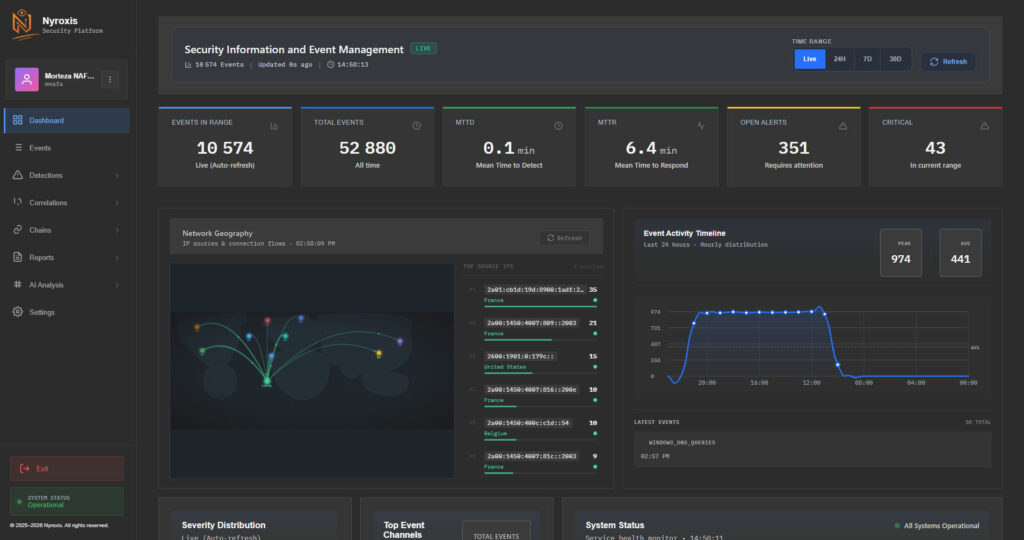
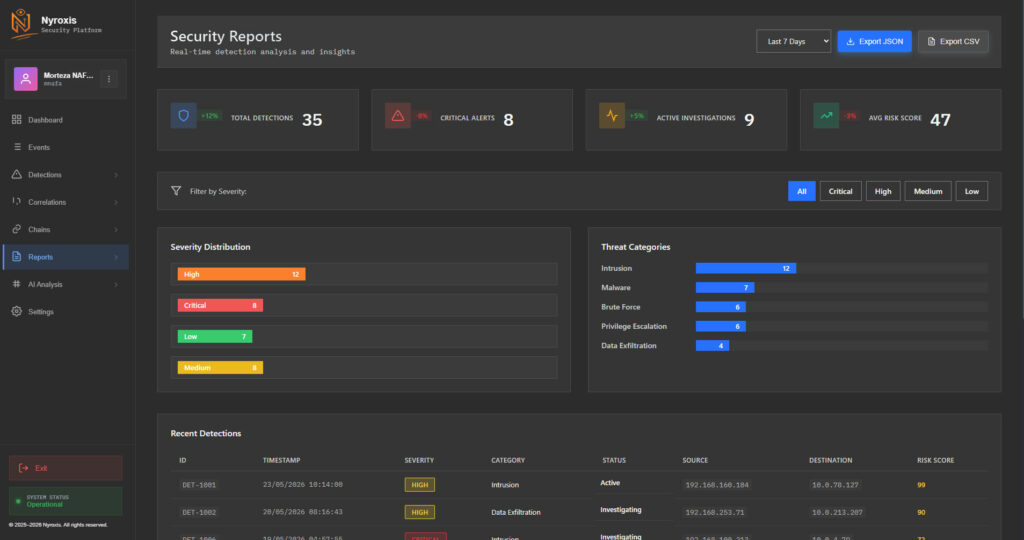
Nyroxis Endpoint SIEM
• Correlation-driven detection and real-time alerting
• Behavioral indicators for anomalous and malicious activity
• Encrypted event storage with integrity and tamper resistance
• Forensic-ready evidence collection and retention
• Designed for minimal noise and operational clarity
About Nyroxis SIEM
Traditional antivirus solutions focus on detecting and removing known malicious files. They typically react only after compromise has occurred and provide limited visibility into how attackers gained access or what actions they performed inside the system.
Nyroxis takes a different approach. As an endpoint-focused SIEM, it continuously monitors system activity, correlates events, and analyzes behavior across processes, networks, and user actions in real time.
When suspicious activity is detected, Nyroxis does not simply terminate the event. Instead, it observes, records, and correlates attacker behavior within a controlled monitoring scope, identifying tactics and preserving forensic evidence.
The result is more than prevention. Nyroxis delivers visibility, traceability, and accountability. enabling security, legal, and investigative teams to understand exactly what happened, how it happened, and respond with confidence.
Stay ahead of threats with Nyroxis
Real-Time Threat Monitoring
Continuous surveillance of your digital environment, detecting suspicious activities the moment they occur.
No delays, no missed alerts.
Smart Intrusion Traps
Unlike traditional defenses that just block, Nyroxis engages attackers in a controlled trap.
mapping their moves, identifying tactics, and gathering evidence.
Actionable Intelligence
Turn raw data into clear, actionable insights so you can respond faster and smarter, staying ahead in the cyber battlefield.
If you or a family member handle sensitive information and operate beyond the scope of ordinary individuals.
Your Next-Level Cyber Defense
Absolute Cyber Vigilance
Nyroxis is a local, silent SIEM system designed for complete monitoring of system activities. It logs and analyzes all suspicious events without interfering with system performance — ideal for high-risk environments and sensitive roles where accurate evidence collection is critical.
--- FIVE CORE MODULES ---
Network Activity Tracking
Process Monitoring
Critical File Integrity Checks
USB & Registry Activity Tracking
Suspicious Event Correlation Engine

Advanced Security Challenges
With customizable alert rules, Nyroxis allows you to instantly detect targeted threats. From monitoring dangerous keywords in PowerShell to spotting unusual USB activity, everything is logged and analyzed in real time.
--- FIVE INTELLIGENT FEATURES ---
Advanced log filtering and search
Multi-level alerts (Critical, Warning, Info)
Multilingual interface (FR/EN/DE)
CSV/JSON export for external analysis
Database optimization and maintenance

New Era, New Defense
Step into the new era of cybersecurity with Nyroxis. Operating silently, fully offline, and without any central server dependency, it ensures security in any environment. From hidden honeypots to legally admissible evidence collection — all in one lightweight, intelligent solution.
--- FIVE STERATEGIC ADVANTAGES ---
No alerting the attacker (Stealth Mode)
Timestamped, legally valid evidence collection
Fully offline operation
Compatibility with sensitive environments
Future integration with central SIEM

Professional Achievements
Incidents That Could Have Been Prevented with Nyroxis
LastPass Breach (2022)
In 2022, attackers compromised the personal home computer of a senior DevOps engineer at LastPass. By installing malware, they gained access to sensitive company vaults stored in the cloud. If Nyroxis had been installed on that home device: Suspicious PowerShell executions and unusual network activity could have been detected and alerted before the breach escalated.

Colonial Pipeline Ransomware Attack 2021
Hackers gained entry to Colonial Pipeline’s network by using login credentials stored on an employee’s personal device. This led to the shutdown of the largest fuel pipeline in the United States for several days. If Nyroxis had been on the employee’s home computer: Unusual VPN connections and abnormal login attempts would have been flagged instantly.

SolarWinds Supply Chain Attack 2020
In this major supply chain attack, intruders first breached personal systems used by some SolarWinds staff. They then inserted malicious code into an official software update, which was distributed to thousands of organizations. If Nyroxis had been installed on those personal systems: Unauthorized executable transfers and suspicious system modifications could have been detected early.

Target Data Breach 2013
Attackers infiltrated Target’s network through a third-party contractor’s personal computer, which was used to connect remotely to the company. This resulted in the theft of millions of customers’ credit card records. If Nyroxis had been on the contractor’s system: Unauthorized network connections and unusual traffic patterns would have triggered alerts before the intrusion succeeded.

Nyroxis Security Plans
Secure your personal and work devices with our advanced offline security monitoring system
Whether you’re an individual, a family member of a sensitive role, or part of a high-security environment, Nyroxis keeps you protected without alerting attackers.
FREE PLAN – Community Edition (Windows)
For personal use & open-source community testingGithub version
ENTERPRISE PLAN – Pro Edition (Multi-Platform)
Full feature set for professionals, VIPs, high-security environmentsContact Us
My Blog
Infostealer Steals OpenClaw AI Agent Configuration Files and Gateway Tokens
Cybersecurity researchers disclosed they have detected a case of an information stealer infection successfully exfiltrating a victim’s OpenClaw (formerly Clawdbot and Moltbot) configuration environment.
“This finding marks a significant milestone in the evolution of infostealer behavior: the transition from stealing browser credentials to harvesting the ‘souls’ and identities of personal AI [
Study Uncovers 25 Password Recovery Attacks in Major Cloud Password Managers
A new study has found that multiple cloud-based password managers, including Bitwarden, Dashlane, and LastPass, are susceptible to password recovery attacks under certain conditions.
“The attacks range in severity from integrity violations to the complete compromise of all vaults in an organization,” researchers Matteo Scarlata, Giovanni Torrisi, Matilda Backendal, and Kenneth G. Paterson said.
Weekly Recap: Outlook Add-Ins Hijack, 0-Day Patches, Wormable Botnet & AI Malware
This week’s recap shows how small gaps are turning into big entry points. Not always through new exploits, often through tools, add-ons, cloud setups, or workflows that people already trust and rarely question.
Another signal: attackers are mixing old and new methods. Legacy botnet tactics, modern cloud abuse, AI assistance, and supply-chain exposure are being used side by side, whichever path
Safe and Inclusive E‑Society: How Lithuania Is Bracing for AI‑Driven Cyber Fraud
Presentation of the KTU Consortium Mission ‘A Safe and Inclusive Digital Society’ at the Innovation Agency event ‘Innovation Breakfast: How Mission-Oriented Science and Innovation Programmes Will Address Societal Challenges’.
Technologies are evolving fast, reshaping economies, governance, and daily life. Yet, as innovation accelerates, so do digital risks. Technological change is no longer
New ZeroDayRAT Mobile Spyware Enables Real-Time Surveillance and Data Theft
Cybersecurity researchers have disclosed details of a new mobile spyware platform dubbed ZeroDayRAT that’s being advertised on Telegram as a way to grab sensitive data and facilitate real-time surveillance on Android and iOS devices.
“The developer runs dedicated channels for sales, customer support, and regular updates, giving buyers a single point of access to a fully operational spyware
Microsoft Discloses DNS-Based ClickFix Attack Using Nslookup for Malware Staging
Microsoft has disclosed details of a new version of the ClickFix social engineering tactic in which the attackers trick unsuspecting users into running commands that carry out a Domain Name System (DNS) lookup to retrieve the next-stage payload.
Specifically, the attack relies on using the “nslookup” (short for nameserver lookup) command to execute a custom DNS lookup triggered via the Windows